First post of winter, brrr! Our nights have consistently been dipping below 0°C now, though not very far below most of the time. Enough to justify a fire in a woodstove and candles everywhere, though! There are about six hours between sunrise and sunset at the moment, though that’s closer to five hours of usable light on a good day, and it’ll drop to four by next month. It’s dark when I leave the house in the morning and dark when I get back from work, so the first time I’ve seen the garden all week was actually Friday afternoon. It keeps me from dwelling too much on outdoor chores, at least.
1. The last of those chores was to dig up the Jerusalem artichokes for storage in the root cellar. The bag I got wasn’t labeled, but I believe these are ‘Red Fuseau’ after reading some descriptions online. I planted only one tuber in the spring, so didn’t know what to expect. That resulting plant has given us a little over 20 tubers of various sizes, so that worked out pretty well! I plan to cook half of them in some sort of soup and plant up the rest this spring in their own bed. In the meantime, they are safely snoozing away in a root cellar bin.

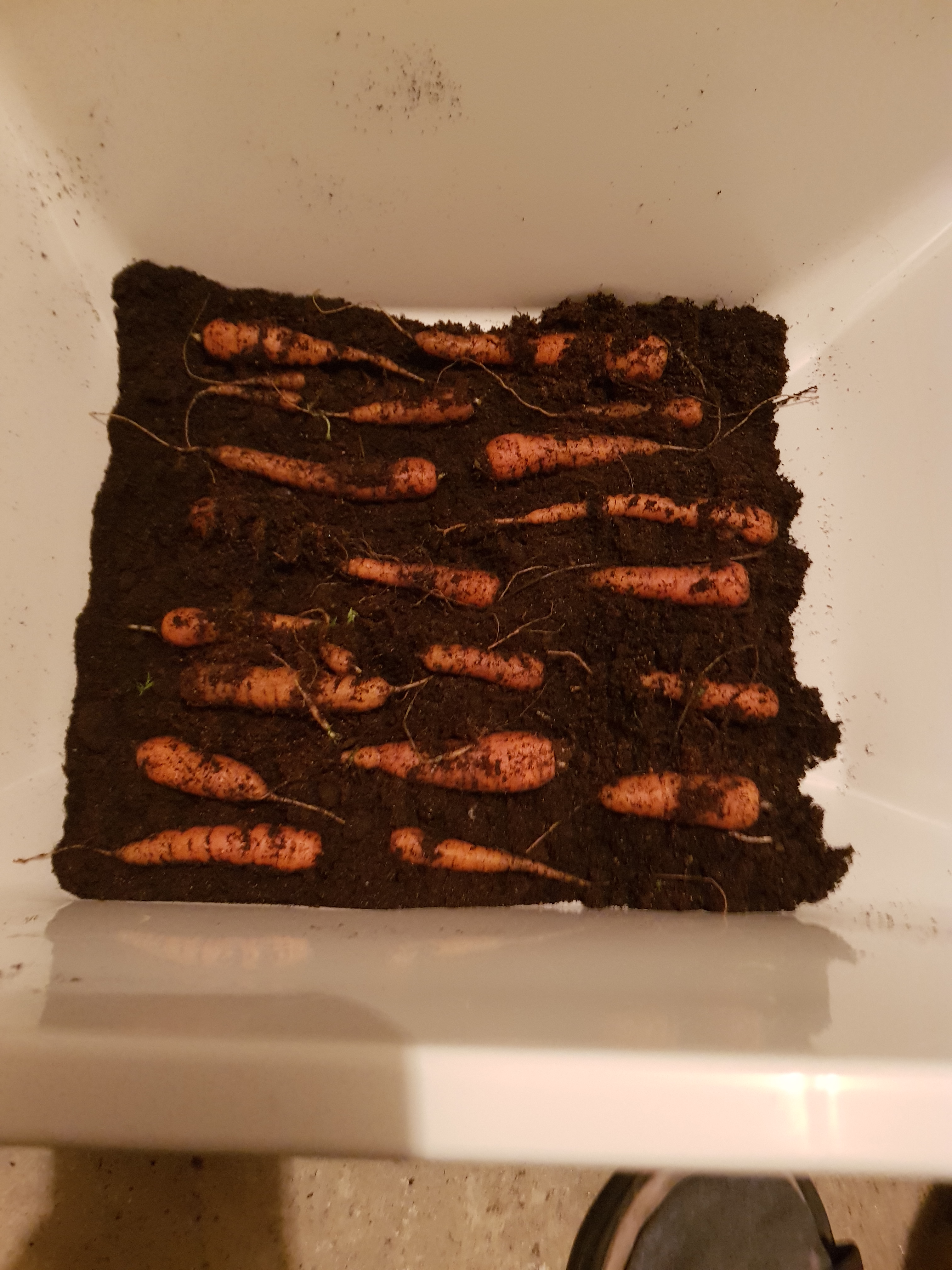
2. Speaking of the root cellar, I was asked for specifics about carrot storage, so I thought I’d show you what I did. I’ve found that carrots and beetroots will survive the winter just fine in a mesh basket in the cellar, though they start to get wrinkly after a few months. Packing them with damp-ish material is supposed to help, so I chucked my first crop of carrots into a big bucket with sterile bagged potting moss. Potting moss mix is made from sphagnum moss (not peat!) which stays nice and airy, absorbs moisture well, and also seems to inhibit microbes. It serves as packing material in the winter and then is used for potting up plants in the spring!
After calculating the amount of space I needed for the rest of the root vegetables, I bought some stacking plastic feed bins to store the rest. Since I harvested the carrots during the wet season, I didn’t bother to dampen the moss, and let it instead suck out any excess moisture from the carrots, to be used later. Roots are placed in the moss so they don’t touch, with a layer of moss separating each layer of carrots like a giant veggie lasagna. Anything else that’s prone to drying out got similar treatment.


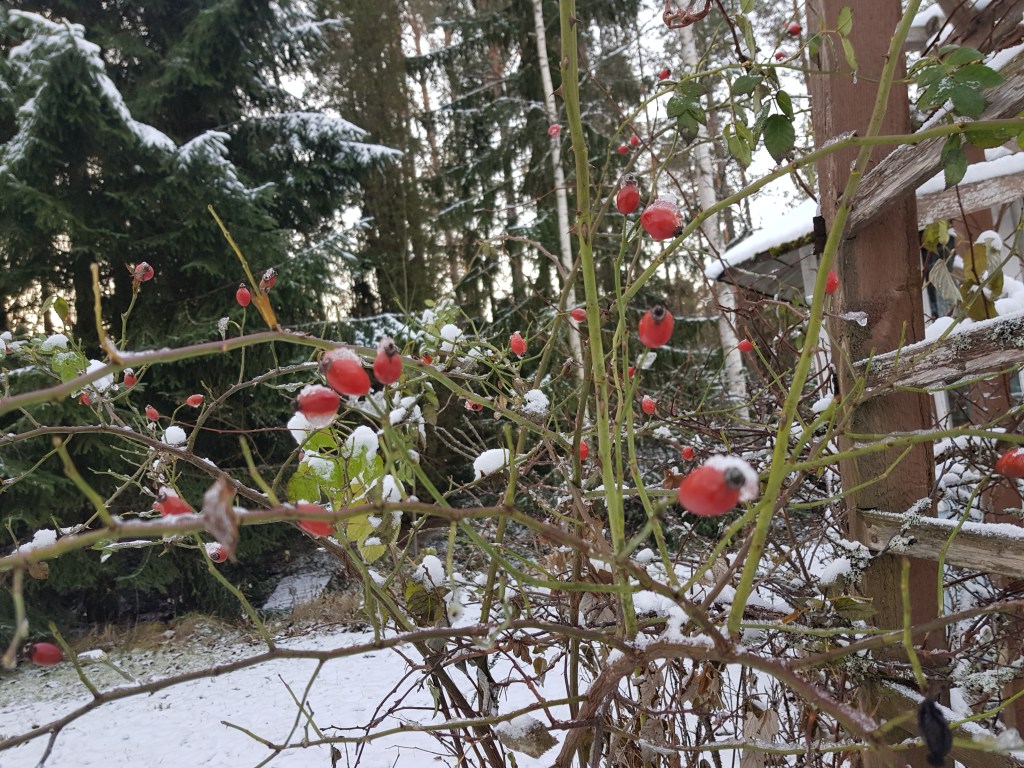
3. A walk in the garden this morning found everything covered by a light layer of snow. Not enough to make for pretty landscape photos yet, though. These rose hips have colored up well and provide welcome relief from all the brown and white. I’m leaving them for the birds, who are currently more interested in emptying the feeder under the kitchen window. That’s been refilled with oil sunflower seeds, which always attract a party. Speaking of sunflower seeds, I shall have to buy new packets for spring because the heads that I harvested last month got eaten by sneaky mice in the barn whilst they were drying! Lesson learned.
4. Back inside we go to visit some green friends. Here are two baby brugmansias. The one on the left is a white one I started from seed. The one on the right is a cutting from a local gardener and should have peach flowers. They will both take a few more years before they are mature enough to bloom, so I am happy that they have adjusted to life under a grow light on a windowsill.

5. Back at the beginning of 2021, I saw this thing on Pinterest about growing your own lemons from seed and decided to try it. They said to go buy a nice organic lemon from the store because those would have the best seeds. So I came home with this big, beautiful lemon from the fancy fruit section, which I let sit on the counter for a few days until I could have some uninterrupted gardening time. I dreamt of a pot full of fragrant little seedlings from this plump paragon of a lemon. Then I finally cut it open to find… it was all flesh and no seeds. Not one. Nada. Oh, the disappointment. It made great lemonade, though.
I still had a pot with a little greenhouse dome prepared for planting, so I rummaged through the fridge drawer and pulled out one of those six-in-a-plastic-net-bag bargain lemons from Lidl and cut the seeds out. They all sprouted and I was giving out baby lemon trees that spring to anyone who wanted one. Here is the one I kept, 2.5 years later.

6. One of our current propagation projects. My son’s Echeveria disintegrated this past summer. Whether it was due to overwatering, underwatering, or some other factor (probably cat-related), we are not certain. He was upset. This kid loves his succulents. I told him not to worry, we could plant them like seeds and get more plants! Thankfully, I was not proven a liar. Look at all the baby Echeverias!

Thanks for visiting and please do check out what the other SoSers are doing over at Jim’s page!
 Little Blue and White House
13 responses to “Six on Saturday | 18th November 2023”
Mice ate the sunflowers in the shed last year, the squirrel ate them this year while they were still on the plants! Love all your cuttings and garden plans, well done.
LikeLiked by 1 person
Oh no! I think some birds got a few seeds while they were still standing, but I didn’t have any raiders until they took out the entire harvest while it was drying. I do have a metal hanging rack (the kind originally meant for pots and pans) that was never installed, so perhaps the new plan is for me to get some power tools and do that myself, so there’s a safe place to hang things this autumn…
LikeLiked by 1 person
Good idea.
LikeLiked by 1 person
Hi, this is a very interesting post this weekend with quite a few things that I will be able to comment on…. Already concerning the 2 brugmansias, it seems to me that the one on the right will probably even be able to give you flower buds from the next summer because it has already started to form a Y (this is the signal that will initiate the production of flower buds). For the other one, you’ll have to wait, I think, for another season.
Regarding the lemon tree, it’s very pretty! You will have to wait 7 or 8 years before you may have flowers, but don’t hesitate to graft ( chip budding ). It’s very easy. I have often tried it, even though I didn’t know anything about it and I have had fruit quickly afterwards. Here is the link to a French site detailing the method: https://greffer.net.pepinature.org/index56d6.html?p=150
LikeLiked by 1 person
That is very exciting news to hear about the brugmansia! They are both due for repotting this spring, now I can look forward to a few peach-colored blooms as well as more lovely foliage. Thanks for the tip about grafting, too — it does not look as difficult as I thought it would be! I did a little online shopping for rootstocks and saw some for dwarfing and cold-resistance, which is even more promising. Will have to do a little experimenting next year 😀
LikeLiked by 1 person
You’re very good at propagating! My brain fixated on the fact that you’re down to 6 hours a day of sunlight. I checked our current figure and its 10 hours. That’s a huge difference but then we don’t get those very long days of sunlight during the summer that you do.
LikeLiked by 1 person
We definitely do get an enforced dormancy period here lol. I actually don’t notice the lack of sunlight as much, however, because I have my plant LED light arrays clipped to nearly every window both in the house and office, set at 12-hour intervals to keep all the plants happy! I suspect it’s true what they say about people working in greenhouses not getting as many seasonal affective issues — sitting near all those lights every day has definitely kept my rhythms far more regular than they were even five years ago, before I started kitting everything out for the plants. As for the midnight sun issue in summer — well, the plants don’t mind at all and I just invest in very good curtains 😀
LikeLike
The baby Echeverias are very cute indeed.
LikeLiked by 1 person
I love Jerusalem artichoke soup! So interesting to read about how you store the root vegetables too.
LikeLiked by 1 person
I only had enough harvest to make one batch of soup, but it was amazing! The texture is a lot of fun to work with and I was so surprised at how creamy the soup turned out. I’ve ordered a mixed pack of different varieties for next year and look forward to trying them all and seeing which ones are our favorites.
LikeLike
That will be interesting to hear about!
LikeLike
An enjoyable look at your plants/veg again Angela. Love those baby Echeverias! We have lots of Jerusalem Artichokes in the garden, but I have decided I don’t like the taste so they just stay there all year round and produce new plants each year. I had no idea there are different varieties! I’m not sure how I would cope with the lack of winter daylight in your part of the world. I just hope you get some nice snow coverage and then sunshine to reflect as much light as possible!
LikeLiked by 1 person
We only got to try one soup with the Jerusalem artichokes so far, but I liked them a lot! They are mild enough that I could probably sneak them into various other dishes without the kid knowing too 😀 I’m actually considering growing them at the edge of the cutting garden as a living wall as well, after seeing how tall they grow and how well they spread. It’d just be an added bonus that I could pull some up for dinner!
LikeLiked by 1 person