Six on Saturday | 7th October 2023

These pumpkins are not from my garden. I purchased them from a local farm and they are now sitting in my classroom, waiting to be turned into jack-o-lanterns by my students later this month. I’m including them because they are such gorgeous pumpkins and I wanted to have some on this blog, even if my own vines were quite dismal this year. If you’re curious about what’s happening in my garden, here are six things now!

1. I have started cleaning up the unruly stand of weeds and baby plum trees that has been plaguing the view from my kitchen window for years. Before I expanded the vegetable garden, it was just a slight eyesore. With the new row in place, it also became a potential source of weeds and blocked a pathway, so cleanup time it was. As usual, I forgot to take a “before” picture for before/after comparisons until I was well into the task. So to the left, you have a “one-quarter into the process” picture instead. On the right, is the current situation. I will finish pruning the trees in late spring since I didn’t want to make any major cuts to the trees we’re keeping, lest they get fungal infections.

2. I have been ogling this Fiskars ergonomic bulb planter all year. My bulb order arrived this past week and I finally had a reason to purchase it! After destroying two flimsy hand-held bulb planters, I was ready to upgrade. Walking out of the store, I felt like I was carrying a medieval weapon — this thing is a meter long and made of heavy steel. It has enough heft to bludgeon any unsuspecting muggers that might come along…. while you’re planting daffodils in the cutting garden at your house in the countryside. As you do.

3. Whilst pulling weeds and planting bulbs, I found a hiding anise hyssop (Agastache foeniculum), winter sown back in January of 2022. I hadn’t seen any sign of them since, so thought that they had all died out. While two little plants aren’t a very impressive survival rate, I’m happy that they’re there and hope that they come back stronger next year.

4. In perhaps an even more dismal showing than the agastache, here is the single nicotiana that actually survived to maturity from an entire packet sown this spring. It’s having a second flush of flowers, probably because of the increased rain. While I appreciate its efforts, I’m not sure if I’ll be planting these again.

5. The corn has finally been producing ears, though I’m not sure how they will fare with the falling temperatures. Then again, the weather has been anything but predictable this year, so I’m letting them carry on until the bitter end. If nothing else, some of them will be small enough to stir fry as baby corn.

6. An experimental bed of fall-sown baby lettuce mix, to see just how late I can keep it going. I’ve got a plastic cover for this bed when it gets cold enough, but suspect the main stumbling block will be when our sunlight dwindles to only a few usable hours per day. Still worth a try, though!

Thanks for visiting and please do check out what the other SoSers are doing over at Jim’s page!

Garden Inventory | Vitis vinifera ‘Zilga’

Alright, storytime! So not far from where we live, there’s an island with three nuclear power plants. The government has been conducting research projects there to find uses for the heat in the wastewater as the cooling system circulates it out of the plants. After all, we’re five degrees of latitude from the Arctic Circle and can use all the heat we can get, no matter what the season. So back in 2001, they ran plastic pipes carrying the heated water under a field, then planted it with grapes and other warm-season crops, effectively providing them with frost-free growing conditions all year round. They are also using the heat for small-scale fish farming. The projects are still ongoing, as far as I know.

Now, a decent percentage of the town population (yours truly and the previous occupants of our house included) have either worked on the island, currently have work associated with it, or have friends and family who have. That’s why cuttings from those experimental grapevines are now living in our garden.

Vitis vinifera ‘Zilga’ (viinirypäle) is a vigorous blue grape of Latvian extraction. It is very cold-hardy, withstanding temperatures down to -40°C, and enthusiastically productive. I suppose even with heated ground, it’s not bad to hedge your bets. Our plants must be nearing two decades old by now, and are in the prime of their lives.

I am not a particularly experienced pruner, so these vines have had to deal with my attempts at learning over the years. Mostly, I just try to keep them neat and ventilated. I made the mistake of allowing them to go unpruned last year and the greenhouse vine has now escaped its confines, insinuating itself into the shrubbery and trees beyond. The vine trellised to our outbuilding has engulfed its supports and most of the wall as well. We have meters and meters of vine, it’s insane. My plan for early next spring is to prune both vines back hard, around the same time as the apple trees. I’ll use the abundance of woody materials to construct a decorative garden hut next to the vegetable beds, hopefully big enough for kids to play in.

Did I mention that these things produce a LOT of grapes? They’re pretty tasty, too, with a hint of blueberry. However, there’s no way our family can eat that many grapes. They are also individually on the small side with plenty of seeds, which makes them not as appealing to kids, despite being very sweet and juicy. Mostly, I steam juice the fruit and can it for use over the winter, often mixed with apple or berry juice. This year, I plan to make grape jelly for the first time. They also make a nice rosé wine and our grapevines’ parents are indeed being used for that purpose. We’re not really wine drinkers, though, so juice it is.

The other thing I always forget to try with these plants is stuffed grape leaves, which I like at restaurants. Hopefully, a note here will remind me next year. Anybody got a good recipe?

Final count:

Vitis vinifera ‘Zilga’ – 2 sprawling vines, one in the greenhouse and one threatening to consume the left side of our outbuilding

In a Vase on Monday | 2nd October 2023

I was going to skip today because of so many repeats, but realistically, I only have a few more days to post before I’ll be forced to skip for lack of materials. So here we go!

Two small bunches next to each other because I don’t have a big squat vase to fit all of them together. The first Chinese asters and lonely white phlox are joined by the dahlias and godetias, which show no signs of slowing down. It’s interesting to see how different the colors look in natural and indoor lighting. Those asters are just so ridiculously bright and cheerful, I hope I can get an entire bouquet’s worth next week.

Do cuttings rooting in water count as being in a vase? Maybe, maybe not. I’m enjoying having all these little jars of herb cuttings lined up, though, so they’re in this post, too. I knew the mints would root fast, but didn’t expect the thymes to be right beside them. The others seem to be dragging their feet in comparison but are probably doing just fine.

This is a post for Rambling in the Garden‘s In a Vase on Monday meme!

Six on Saturday | 30th September 2023

The great thing about doing garden work once autumn fully sets in is knowing that places you tidy up will stay relatively tidy for a while. When you’re out there pulling up all the dead plant material and come across some weeds, you can just tell them “Y’know, can we just… not?” and they’ll usually be very agreeable to your suggestion. The mornings are getting chillier and they’re just about as ready to wrap things up as I am.

1. The second aisle of the vegetable garden has been covered in bark mulch, making everything much neater-looking. It might be hard to see in the back of the picture, but there are metal rose arches over the end of each pathway, anchored into the beds. Those will be covered in runner beans next summer, though I’ll probably be adding more supports to prepare for all the beans we want. Also new are two wooden whisky half barrels to replace the big green plastic tub that my mints are currently growing in. Given how much I clipped for tea this year, it seemed a good idea to double the amount and grow a lot of cuttings indoors over the winter.

2. The mixed packet of Callistephus chinensis I randomly flung into the cutting garden didn’t die after all! I seeded them in the middle of the June dry spell, so I didn’t hold out much hope for them. Then last week I was surprised to find them while doing some long overdue weeding, already in bud. So I have asters this autumn! The very first plant I ever grew as a child was an aster. The last time I grew these was for my bridesmaids’ bouquets nearly twelve years ago. Wow, that makes me feel old.

3. Japanese ginger (Zingiber mioga) is looking very healthy. Apparently, it is quite hardy, so it’ll be moved to a vegetable garden bed when I start pulling sunken pots for overwintering in a few weeks. Perhaps with a bit of extra mulch, just to be safe. The shoots and flowers are edible, so we should be able to harvest a few next spring.

4. This is not the Phlox paniculata I expected when I planted it, but it is the color that I got. At least it’s not more of the bright pink we already have in the raspberry bed. In keeping with the developing theme of “unexpected things in the garden”, it earned its spot today.

5. I did not plant this clematis. I had been considering getting a clematis next spring, however, and that was apparently enough to make this appear. Upon consulting my list of legacy plants, this could possibly be Clematis ‘Blue Angel’. In which case, it’s been hiding from me for over a decade. I’m going to guess it’ll survive until next year when I can dig it out of that mess of weeds and find it a better place to climb.

6. Rose ‘Gertrude Jekyll’ has big plans for next year. This four-foot watershoot popped up just this past week and I think one of the other roses is following suit. Hopefully, it won’t get too damaged this winter.

Thanks for visiting and please do check out what the other SoSers are doing over at Jim’s page!

Garden Inventory | Pyrus communis ‘Pepi’
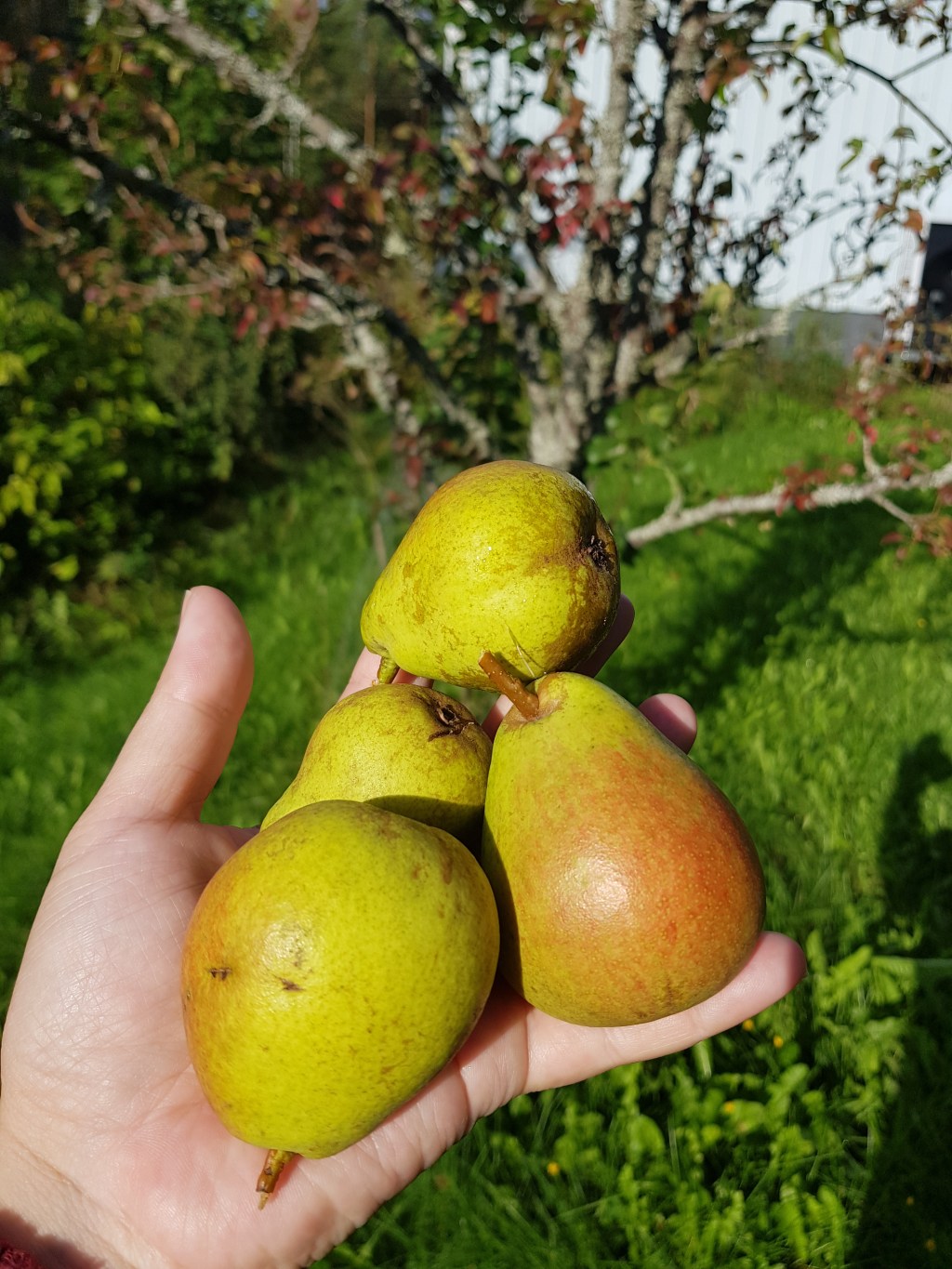
Pyrus communis ‘Pepi’ (päärynä) is a pear tree originally bred in Estonia, so it does great in our cold winters. The fruits are abundant and ready to harvest pretty early for a pear — usually in early September. I’ve read that this is a smaller variety and that pear trees grow slowly, to begin with, both facts which seem to be pretty well-represented here. It is the only tree I don’t have to harvest with a ladder, giving it a special place in my heart.

Unlike the other fruit trees that came with the house, this one is relatively young, having only been planted a few years before we moved in. That still makes it well over a decade old, however, and it has grown remarkably little in that time. Besides being cold-hardy, Pepi has also been super healthy, never having any foliar or insect problems. There was originally another garden pear planted with it, for cross-pollination, but that one died early on and a wild pear has grown from the rootstock to replace it. (That’s the giant green tree directly behind Pepi in the first picture, if you’re wondering).

I also planted a “family” pear this summer, which grows three different varieties on different branches. One of those branches grows ‘Pepi’. That’s the sapling in the last picture. It has not fruited yet, so we will see how that turns out in the following years.

The pears from this tree are sweet and soft… when they are picked on time and ripen successfully. My timing is still a little hit or miss in this regard. In theory, you’re supposed to start tasting them in late August and pick them when they’re sweet and start to get a blush. In practice, most times I’ve run out with a bucket when the first few are falling off the tree. Most of them are good at that point, but there will be several that are a bit overripe and have started turning brown in the middle. Ick.

This year, we ended up with only a few large fruits, due to the double whammy of our pruning the tree last year and wonky pollination issues from this year’s dry spring. Thus, I ended up with a handful of large fruit that I picked too late to be very tasty.

When you do get to them on time, though, Pepi pears are best for fresh eating. They are quite sweet and smooth, though I can’t say I’ve tasted enough different pears to be able to differentiate flavors. I’ve also juiced these in the past and preserved them as canned pear sauce.

Final count:

  • Pyrus communis ‘Pepi’ – 1 smallish tree and 1 branch of a multi-variety tree

In a Vase on Monday | 25th September 2023

I seem to have ended up with mostly single-species vases this week, but that’s down to there being lots of big statement stems appearing in the garden. No complaints about that!

‘Bizar Dutch’ gladiolus, which came in a completely mislabeled package but was quickly identified with a Google search. Thank you, internet. I really do love two-toned flowers and hope I can get these to return next year. I remembered to sink the corms in pots this spring, so saving them will require a lot less digging, thank goodness. (Please disregard the scary-looking stains on the wall, that’s where the woodstove connects to the flue and sometimes a bit of ash escapes.)

Two ‘Moonwalker’ sunflowers and one bird feeder sunflower are keeping me company at the kitchen table. Hopefully, the cats won’t decide to take a nibble, but it will not affect their health if they do. That doesn’t mean they won’t get scolded, however, because they know better.

The godetias are still flowering up a storm. I am beyond impressed with the longevity of these things, both in the ground and in the vase. They seem to greatly enjoy Finnish summers. I hope they will self-seed for next year like the articles say, and must cover some of the pods with seed-catching bags for insurance.

Two orange ‘Neon Splendor’ dahlias, looking a little less than neon in the bright light. That red dahlia is a random bedding plant I grew from seed, but its flowers are really big!

I accidentally knocked this poor little begonia blossom off the plant while I was cutting dahlias, so it has been given its own little cup to sit in on the windowsill.

Finally, the hydrangeas have been brought in to greet visitors at the entryway. The last time I did this, they dried wonderfully and looked almost the same over the entire winter.

This is a post for Rambling in the Garden‘s In a Vase on Monday meme!

Six on Saturday | 23rd September 2023

It’s been a gentle September, a couple of chilly nights aside. With the mellow temperatures and increased rainfall has come an amazing mushroom foraging season. The late autumn mushrooms are appearing earlier and the late summer mushrooms are still out in droves, so that I can’t walk from the house to the garage without coming across an edible mushroom. After only wandering within a 500-meter radius of the house for a couple of hours, I had 4 full baskets totaling 6.26kg of mushrooms. Guess who is spending the weekend preserving all that?

1. The golden chanterelle (Cantharellus cibarius) is plentiful in Finnish woodlands and easy to spot once you know what you’re looking for. This year, they have gone completely nuts. Clumps are growing on the neighbor’s lawn. I took out the garbage and came back with a handful of chanterelles. Luckily, they are also our favorite and can be used in countless different ways. Mushroom pasta and risotto are especially popular in our household.

2. Funnel chanterelles (Craterellus tubaeformis) have been growing very large this year, many as big as the yellows. They can pretty much be substituted for each other in just about any recipe. The funnels usually don’t start sprouting until next month, but I’m not complaining.

3. Another chanterelle relative, the hedgehog mushroom is also plentiful in our woods. The one in the picture is the more common Hydnum repandum but we also have a clump of Hydnum rufescens growing under our clothes drying rack. These first three are all pretty much interchangeable in recipes and have very similar flavors, though I like the firm texture of the hydnums the best.

4. A group picture of all the different species sorted into their own baskets. Also included so I can show the two porcinis (Boletus edulis) I found next to the swing set in the top left basket.

5. These are not the yellow and red ‘Jackpot’ gladiolus I expected when planting these bulbs, but I prefer whatever it is I ended up with. They fit in better with the color scheme of the rest of my plants, honestly. Don’t tell that to my son, though — he chose the bulbs because he likes orange.

6. The double red begonias finally decided to show themselves, right when I’d given them up as a lost cause. I admit that they are pretty, though perhaps they might just stay on the terrace in a pot next year.

Thanks for visiting and please do check out what the other SoSers are doing over at Jim’s page!

Six on Saturday | 16th September 2023

Autumn activities are in full swing this week! We had a cold snap two nights ago, hitting a low of 2°C, so there was a lot of mad scrambling to get all the houseplants back inside that evening. Next week, we will officially start dipping below 10°C most evenings, so it is time to start clearing out the summer veggies that I know will not manage to ripen any further (I’m looking at you, underwhelming tomatoes). It’ll be nice to clean up, scale down, and rest for a bit, after the wild fluctuations this year in the garden. We’re not completely done yet, of course — I will be trying autumn/winter crops this year, so that will be an interesting challenge.

1. The potted cyclamens on our front porch and terrace are enjoying the cool damp weather. They will be transplanted to a bed under the front pines when they’re done doing their thing.

2. Harvesting continues at a good pace! I tried my hand at braiding onions for the first time and am inordinately pleased with the results. These ‘Sturon’ yellow onions will only last a couple of months at most, but I can easily use them up by then. I’d like to fill a couple of beds with longer-storing varieties next year and try to grow our year’s worth so I never have to rush to the store again. They also provide the bonus crop of onion greens in the summer, which I froze a good amount of for use in soups.

3. During a brief window of dry weather, I dug up the last two beds of Mozart potatoes and brought them into the barn to cure. This wasn’t our best year for potatoes and I know the drought affected the other two varieties we grew since they produced only small to medium-sized tubers. Mozart seemed to fare better, giving us a good amount of medium-sized tubers and several chunky ones too. It also hasn’t been affected in the least by scab or hungry bugs, which seemed to plague our Annabelles. All in all, we fell far short of the winter’s supply of potatoes I was aiming for, but have at least a month’s worth, which isn’t bad. I will be growing half my crop in potato bags next year, in the hope that it will help to combat some of those problems.

4. ‘Moonwalker’ sunflowers are giving the trees some competition! The shortest ones are about 8 feet. I had to crane my head up and photograph from several feet back to get that picture. Very pleased with the result and am going to try growing an entire row of similar-height sunflowers across the back of the cutting garden as a living screen next year.

5. I was sure that this mophead hydrangea (which came with the house, so no name) had died a few years back, but it made a surprise reappearance this autumn through the middle of some overgrown cypress branches sporting not one but four big flower heads. I’ll give it a few weeks, then move it over to the cutting garden with the other hydrangeas, where it won’t be strangled by nearby trees.

6. This wild pear popped up from the rootstock of a dead grafted tree and we’ve been letting it grow out of curiosity. It flowered the last few years, but this is the first year it has managed to set fruit too. I’m curious to try some of it in jam, especially since our domestic pear tree didn’t produce much this year.

Thanks for visiting and please do check out what the other SoSers are doing over at Jim’s page!

Garden Inventory | Malus domestica ‘Red Cinnamon’

I’ve had this post in drafts since the beginning of summer, as one thing or another kept my attention from working on it. That’s often how I feel about harvesting this particular apple tree as well, because it ripens in the first weeks of September, just when it gets harder to find any time in the garden due to work. It doesn’t deserve to be put off, yet it happens year after year.

Malus domestica ‘Red Cinnamon’ (omena ‘Punakaneli’) is an mid-season apple which is great for fresh eating and baking. It can also be stored for a month or so in the cellar. It arrived from Russia in the late 19th century and is now the most popular apple variety grown in Finland.

Our specific Punakaneli tree was planted at the same time as the other older trees, in the 1950s. We’ve found it to be slower-growing than White Transparent, but also generally healthier. In fact, this tree was hit by lightning decades ago and has carried on growing perfectly well since. It also doesn’t seem to be as prone to worms as the earlier ripening apples.

Despite having “red” in its name, this apple usually only has a blush of red over yellowish green when we pick it. It’s very crisp and juicy, with the advertised hint of cinnamon. It is sweeter than our other apple, but often doesn’t bear as much fruit. They get used in much the same way as our other apples, and I often steam juice them together with sour crabapples that are available around the same time. The resulting juice has a much fuller flavor than juice made from earlier apples.

Final count:

  • Malus domestica ‘Red Cinnamon’ – 1 elderly tree

In a Vase on Monday | 11th September 2023

A small vase update this week, but an update nonetheless. I’m particularly happy with the first arrangement because I’m getting the hang of balancing flowers so that the heights are a bit more layered! More oranges and reds appearing, as if I needed a reminder that it’s autumn.

Two white-tipped ‘Holland Festival’ dahlias, the first bright orange ‘Neon Splendor’ dahlia, and a pretty bright red unnamed bedding dahlia. Yellow Austin rose ‘The Poet’s Wife’, godetias, and an unidentified pretty apricot rose round it out. That apricot-colored rose is super fragrant and came from a miniature rose plant that I got last mother’s day! They overwintered in the ground very well and I love that the plants stay small but still produce full-sized blossoms.

Last time I said that rose lilies don’t appear to open all the way. I’ll have to amend that to “they don’t seem to open all the way in a vase, but do so in the garden just fine”. Notice that it only has three anther stalks (pollenless) rather than the typical six! I do like how much less mess they make, but the trade-off is that they also are less fragrant.

This is a post for Rambling in the Garden‘s In a Vase on Monday meme!