The first week of November caught me off guard this year, though really it shouldn’t have. You’d think after several Finnish winters I’d have learned by now that the darkness doesn’t arrive so much as it simply refuses to leave once it shows up on a Friday mid-afternoon. We’ve had nothing but overcast skies for days now — that particular shade of grey which makes you wonder if the sun isn’t just a pleasant shared delusion we’ve all agreed to believe in, like Santa Claus or the idea that you’ll eventually get around to organizing that one kitchen drawer.


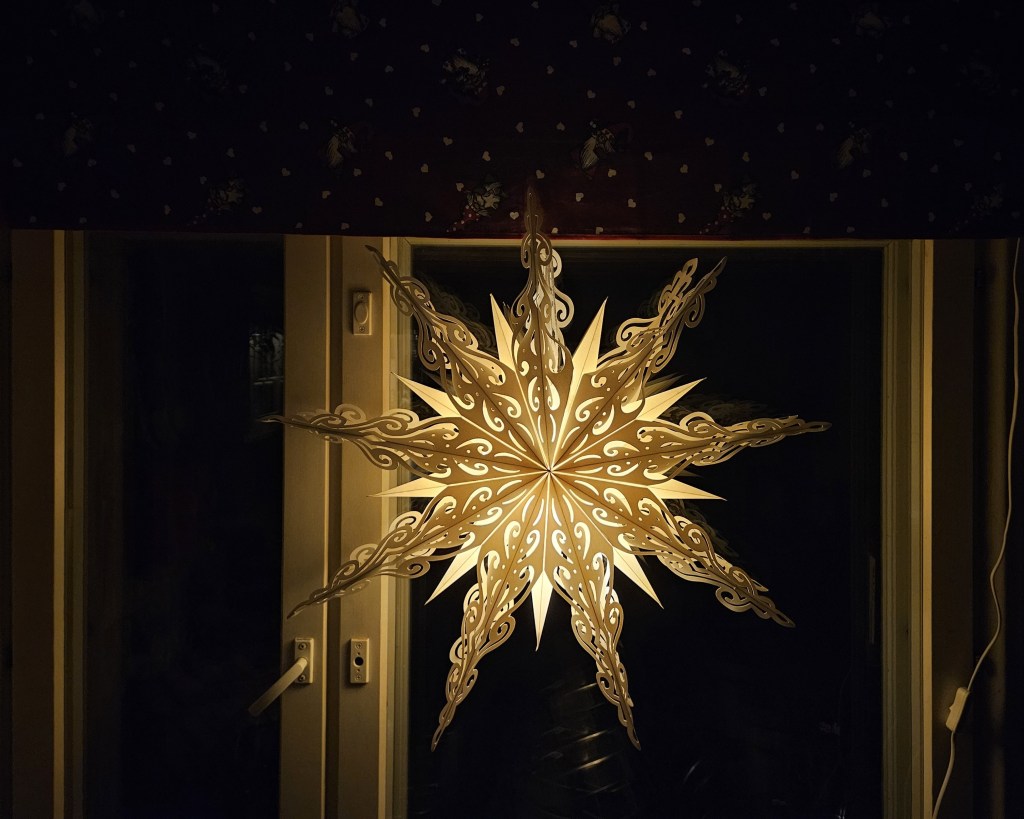
I started putting up the window stars yesterday.
This is not something I would have understood the point of in my previous life in Southern California, where “holiday decorating” meant my parents would haul out our slightly lopsided artificial tree sometime around December 15th if we were feeling particularly festive. Maybe some lights would go up on the eaves, but that was largely a concession to neighborhood aesthetics — the kind of thing you did because everyone else was doing it and you didn’t want to be the house that looked like it was making some kind of statement about Refusing To Participate. Christmas lights were for decoration, for competition even, but never really for anything resembling actual function.
Here, though. Here it’s different.


The thing about Nordic darkness (and I mean the real kind, the November-through-February kind, not just “oh it gets dark earlier”) is that it fundamentally changes your relationship with light. You stop thinking of illumination as ambient, as something that just sort of exists in the background of your day. Instead, light becomes intentional. Light becomes architecture. You plan for it, you cultivate it, you place it with the same care you might give to arranging furniture or companion planting rotations. (Though to be fair, the vegetable situation up here requires a similar level of strategic planning, given that we’re working with approximately four months of “maybe you can grow things” weather.)
I’d noticed, in those first couple of winters, how all the houses had these glowing stars in their windows. Paper ones, plastic ones, elaborate ones made of thin strips of wood that cast intricate shadows. At first I thought it was charming in that vaguely folkloric way that makes expats get all misty-eyed about “authentic traditions.” And sure, it is traditional — Finns have been doing this for ages. But what I didn’t grasp until I’d lived through enough pitch-black 3 PM afternoons was that these aren’t just pretty decorations. They’re wayfinding.
Picture this: it’s a quarter past four and you’ve been working at your desk (or, let’s be honest, staring at your phone wondering how it’s already dark again) and you need to navigate from one room to another. You could turn on every overhead light in your path like some kind of illumination-obsessed eccentric, wasting electricity and money and completely destroying whatever cozy hygge* situation you’ve managed to cultivate. Or — and here’s where the Finnish pragmatism really shines — you could have gentle glowing landmarks stationed in your windows, providing just enough light to see where you’re going without having to fumble for switches or stub your toe on that chair that’s been in the same place for three years but somehow still catches you by surprise.


I started collecting these stars the way I suspect a lot of people do: by haunting the post-Christmas sales aisles where everything is marked down to nearly nothing because apparently the day after Christmas is when holiday decorations become about as desirable as last week’s newspapers. This is how I’ve acquired a small but respectable collection of paper stars in varying sizes, colors ranging from classic white to a rather assertive red that I’m not entirely sure about but which was too cheap to pass up. There’s one delicate lace-patterned one that I’m particularly fond of, though it’s so lightweight I have to be careful about opening windows near it.
The irony isn’t lost on me that I’ve become the person who puts up Christmas decorations in early November. Growing up, this would have seemed unconscionably premature — the kind of thing that prompted eye-rolling and muttered comments about “rushing the season.” But when your season involves three and a half hours of twilight passing for daylight, you take your festivity where you can get it. Besides, I’ve come to appreciate the Finnish approach to holiday timing, which seems to operate on the principle that if you’re going to haul yourself through several months of darkness, you might as well make it pretty while you’re at it.


So now our little blue and white house glows from within after 4 PM, with stars, candelabras and twinkle lights stationed in strategic windows like tiny lighthouses guiding us from room to room. I’ll add more of those candelabras soon — another fixture I’ve learned to appreciate, those simple brass or wooden structures with their promise of actual flame, though the electric ones work just as well and don’t require the same level of vigilance about not burning the house down. The cat seems uncertain about these new additions to her environment. She spent the last day watching the stars with that particular intensity cats reserve for objects they’re trying to decide whether or not to destroy.
Would I have chosen to put up holiday decorations this early in my California life? Probably not. But then again, I wouldn’t have understood why anyone would need to. When your winters involve temperatures dropping to a brisk 60°F and maybe having to wear a light jacket in the evenings, the whole concept of winter survival decorating doesn’t really compute. Here, though, where the darkness arrives like an overnight houseguest who overstays their welcome by several months, these glowing paper stars stop being quaint traditional crafts and start being what they actually are: tiny acts of defiance against the void. Or possibly just really sensible interior navigation aids. Both things can be true.

Either way, I can now make it from the bedroom to the kitchen without turning on a single overhead light, guided entirely by the warm glow of discount stars I bought for two euros apiece. If that’s not the definition of successful adaptation to Nordic life, I don’t know what is.

* Hygge is totallly a Danish thing, actually, and I’m sure I’d get disapproving looks if anybody I knew read this. Look up kalsarikännit if you want a more authentic Finnish perspective on comfort.