In a Vase on Monday | 2nd October 2023

I was going to skip today because of so many repeats, but realistically, I only have a few more days to post before I’ll be forced to skip for lack of materials. So here we go!

Two small bunches next to each other because I don’t have a big squat vase to fit all of them together. The first Chinese asters and lonely white phlox are joined by the dahlias and godetias, which show no signs of slowing down. It’s interesting to see how different the colors look in natural and indoor lighting. Those asters are just so ridiculously bright and cheerful, I hope I can get an entire bouquet’s worth next week.

Do cuttings rooting in water count as being in a vase? Maybe, maybe not. I’m enjoying having all these little jars of herb cuttings lined up, though, so they’re in this post, too. I knew the mints would root fast, but didn’t expect the thymes to be right beside them. The others seem to be dragging their feet in comparison but are probably doing just fine.

This is a post for Rambling in the Garden‘s In a Vase on Monday meme!

Six on Saturday | 30th September 2023

The great thing about doing garden work once autumn fully sets in is knowing that places you tidy up will stay relatively tidy for a while. When you’re out there pulling up all the dead plant material and come across some weeds, you can just tell them “Y’know, can we just… not?” and they’ll usually be very agreeable to your suggestion. The mornings are getting chillier and they’re just about as ready to wrap things up as I am.

1. The second aisle of the vegetable garden has been covered in bark mulch, making everything much neater-looking. It might be hard to see in the back of the picture, but there are metal rose arches over the end of each pathway, anchored into the beds. Those will be covered in runner beans next summer, though I’ll probably be adding more supports to prepare for all the beans we want. Also new are two wooden whisky half barrels to replace the big green plastic tub that my mints are currently growing in. Given how much I clipped for tea this year, it seemed a good idea to double the amount and grow a lot of cuttings indoors over the winter.

2. The mixed packet of Callistephus chinensis I randomly flung into the cutting garden didn’t die after all! I seeded them in the middle of the June dry spell, so I didn’t hold out much hope for them. Then last week I was surprised to find them while doing some long overdue weeding, already in bud. So I have asters this autumn! The very first plant I ever grew as a child was an aster. The last time I grew these was for my bridesmaids’ bouquets nearly twelve years ago. Wow, that makes me feel old.

3. Japanese ginger (Zingiber mioga) is looking very healthy. Apparently, it is quite hardy, so it’ll be moved to a vegetable garden bed when I start pulling sunken pots for overwintering in a few weeks. Perhaps with a bit of extra mulch, just to be safe. The shoots and flowers are edible, so we should be able to harvest a few next spring.

4. This is not the Phlox paniculata I expected when I planted it, but it is the color that I got. At least it’s not more of the bright pink we already have in the raspberry bed. In keeping with the developing theme of “unexpected things in the garden”, it earned its spot today.

5. I did not plant this clematis. I had been considering getting a clematis next spring, however, and that was apparently enough to make this appear. Upon consulting my list of legacy plants, this could possibly be Clematis ‘Blue Angel’. In which case, it’s been hiding from me for over a decade. I’m going to guess it’ll survive until next year when I can dig it out of that mess of weeds and find it a better place to climb.

6. Rose ‘Gertrude Jekyll’ has big plans for next year. This four-foot watershoot popped up just this past week and I think one of the other roses is following suit. Hopefully, it won’t get too damaged this winter.

Thanks for visiting and please do check out what the other SoSers are doing over at Jim’s page!

Garden Inventory | Pyrus communis ‘Pepi’
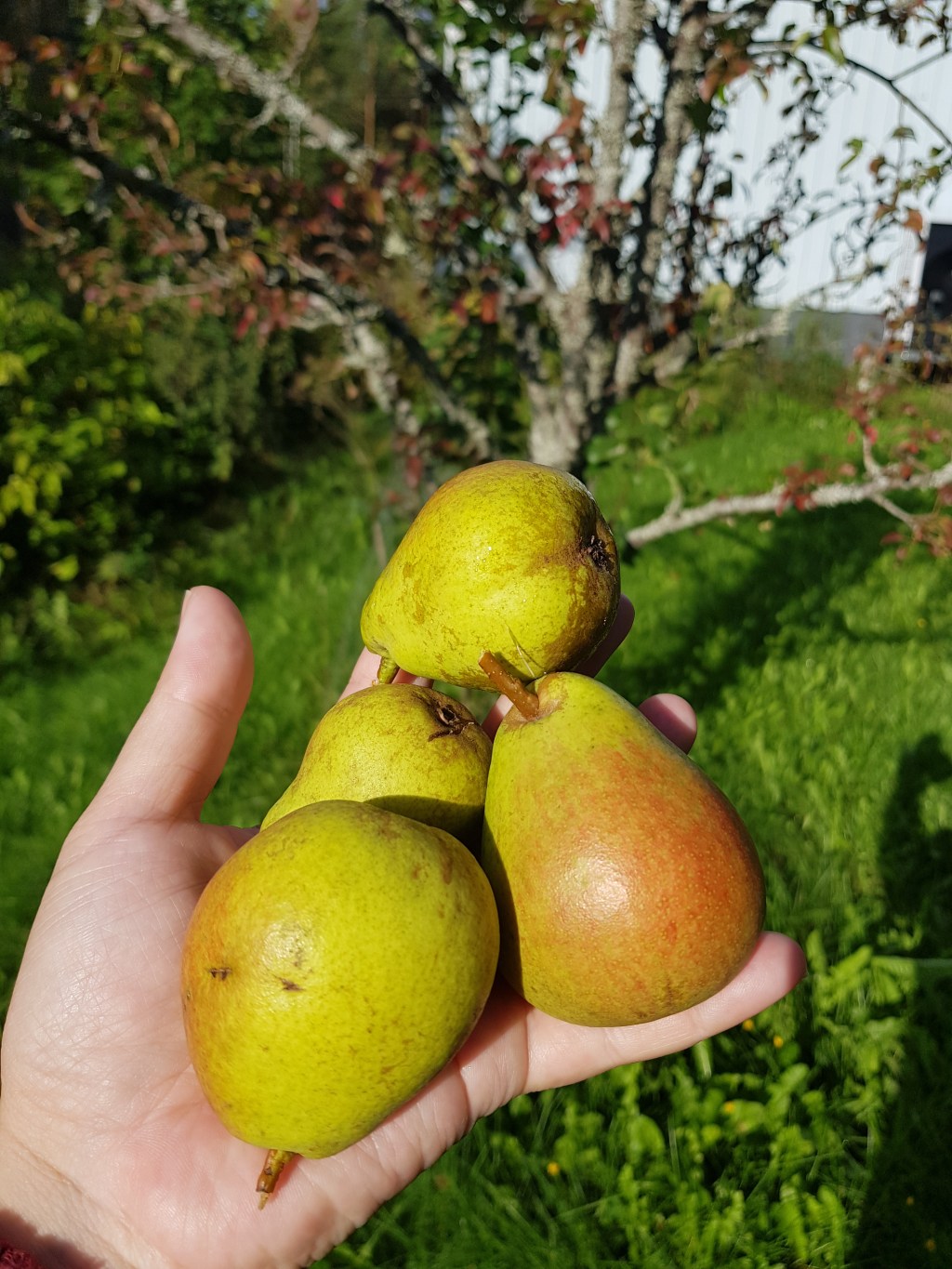
Pyrus communis ‘Pepi’ (päärynä) is a pear tree originally bred in Estonia, so it does great in our cold winters. The fruits are abundant and ready to harvest pretty early for a pear — usually in early September. I’ve read that this is a smaller variety and that pear trees grow slowly, to begin with, both facts which seem to be pretty well-represented here. It is the only tree I don’t have to harvest with a ladder, giving it a special place in my heart.

Unlike the other fruit trees that came with the house, this one is relatively young, having only been planted a few years before we moved in. That still makes it well over a decade old, however, and it has grown remarkably little in that time. Besides being cold-hardy, Pepi has also been super healthy, never having any foliar or insect problems. There was originally another garden pear planted with it, for cross-pollination, but that one died early on and a wild pear has grown from the rootstock to replace it. (That’s the giant green tree directly behind Pepi in the first picture, if you’re wondering).

I also planted a “family” pear this summer, which grows three different varieties on different branches. One of those branches grows ‘Pepi’. That’s the sapling in the last picture. It has not fruited yet, so we will see how that turns out in the following years.

The pears from this tree are sweet and soft… when they are picked on time and ripen successfully. My timing is still a little hit or miss in this regard. In theory, you’re supposed to start tasting them in late August and pick them when they’re sweet and start to get a blush. In practice, most times I’ve run out with a bucket when the first few are falling off the tree. Most of them are good at that point, but there will be several that are a bit overripe and have started turning brown in the middle. Ick.

This year, we ended up with only a few large fruits, due to the double whammy of our pruning the tree last year and wonky pollination issues from this year’s dry spring. Thus, I ended up with a handful of large fruit that I picked too late to be very tasty.

When you do get to them on time, though, Pepi pears are best for fresh eating. They are quite sweet and smooth, though I can’t say I’ve tasted enough different pears to be able to differentiate flavors. I’ve also juiced these in the past and preserved them as canned pear sauce.

Final count:

  • Pyrus communis ‘Pepi’ – 1 smallish tree and 1 branch of a multi-variety tree

Six on Saturday | 23rd September 2023

It’s been a gentle September, a couple of chilly nights aside. With the mellow temperatures and increased rainfall has come an amazing mushroom foraging season. The late autumn mushrooms are appearing earlier and the late summer mushrooms are still out in droves, so that I can’t walk from the house to the garage without coming across an edible mushroom. After only wandering within a 500-meter radius of the house for a couple of hours, I had 4 full baskets totaling 6.26kg of mushrooms. Guess who is spending the weekend preserving all that?

1. The golden chanterelle (Cantharellus cibarius) is plentiful in Finnish woodlands and easy to spot once you know what you’re looking for. This year, they have gone completely nuts. Clumps are growing on the neighbor’s lawn. I took out the garbage and came back with a handful of chanterelles. Luckily, they are also our favorite and can be used in countless different ways. Mushroom pasta and risotto are especially popular in our household.

2. Funnel chanterelles (Craterellus tubaeformis) have been growing very large this year, many as big as the yellows. They can pretty much be substituted for each other in just about any recipe. The funnels usually don’t start sprouting until next month, but I’m not complaining.

3. Another chanterelle relative, the hedgehog mushroom is also plentiful in our woods. The one in the picture is the more common Hydnum repandum but we also have a clump of Hydnum rufescens growing under our clothes drying rack. These first three are all pretty much interchangeable in recipes and have very similar flavors, though I like the firm texture of the hydnums the best.

4. A group picture of all the different species sorted into their own baskets. Also included so I can show the two porcinis (Boletus edulis) I found next to the swing set in the top left basket.

5. These are not the yellow and red ‘Jackpot’ gladiolus I expected when planting these bulbs, but I prefer whatever it is I ended up with. They fit in better with the color scheme of the rest of my plants, honestly. Don’t tell that to my son, though — he chose the bulbs because he likes orange.

6. The double red begonias finally decided to show themselves, right when I’d given them up as a lost cause. I admit that they are pretty, though perhaps they might just stay on the terrace in a pot next year.

Thanks for visiting and please do check out what the other SoSers are doing over at Jim’s page!

Six on Saturday | 16th September 2023

Autumn activities are in full swing this week! We had a cold snap two nights ago, hitting a low of 2°C, so there was a lot of mad scrambling to get all the houseplants back inside that evening. Next week, we will officially start dipping below 10°C most evenings, so it is time to start clearing out the summer veggies that I know will not manage to ripen any further (I’m looking at you, underwhelming tomatoes). It’ll be nice to clean up, scale down, and rest for a bit, after the wild fluctuations this year in the garden. We’re not completely done yet, of course — I will be trying autumn/winter crops this year, so that will be an interesting challenge.

1. The potted cyclamens on our front porch and terrace are enjoying the cool damp weather. They will be transplanted to a bed under the front pines when they’re done doing their thing.

2. Harvesting continues at a good pace! I tried my hand at braiding onions for the first time and am inordinately pleased with the results. These ‘Sturon’ yellow onions will only last a couple of months at most, but I can easily use them up by then. I’d like to fill a couple of beds with longer-storing varieties next year and try to grow our year’s worth so I never have to rush to the store again. They also provide the bonus crop of onion greens in the summer, which I froze a good amount of for use in soups.

3. During a brief window of dry weather, I dug up the last two beds of Mozart potatoes and brought them into the barn to cure. This wasn’t our best year for potatoes and I know the drought affected the other two varieties we grew since they produced only small to medium-sized tubers. Mozart seemed to fare better, giving us a good amount of medium-sized tubers and several chunky ones too. It also hasn’t been affected in the least by scab or hungry bugs, which seemed to plague our Annabelles. All in all, we fell far short of the winter’s supply of potatoes I was aiming for, but have at least a month’s worth, which isn’t bad. I will be growing half my crop in potato bags next year, in the hope that it will help to combat some of those problems.

4. ‘Moonwalker’ sunflowers are giving the trees some competition! The shortest ones are about 8 feet. I had to crane my head up and photograph from several feet back to get that picture. Very pleased with the result and am going to try growing an entire row of similar-height sunflowers across the back of the cutting garden as a living screen next year.

5. I was sure that this mophead hydrangea (which came with the house, so no name) had died a few years back, but it made a surprise reappearance this autumn through the middle of some overgrown cypress branches sporting not one but four big flower heads. I’ll give it a few weeks, then move it over to the cutting garden with the other hydrangeas, where it won’t be strangled by nearby trees.

6. This wild pear popped up from the rootstock of a dead grafted tree and we’ve been letting it grow out of curiosity. It flowered the last few years, but this is the first year it has managed to set fruit too. I’m curious to try some of it in jam, especially since our domestic pear tree didn’t produce much this year.

Thanks for visiting and please do check out what the other SoSers are doing over at Jim’s page!

Garden Inventory | Malus domestica ‘Red Cinnamon’

I’ve had this post in drafts since the beginning of summer, as one thing or another kept my attention from working on it. That’s often how I feel about harvesting this particular apple tree as well, because it ripens in the first weeks of September, just when it gets harder to find any time in the garden due to work. It doesn’t deserve to be put off, yet it happens year after year.

Malus domestica ‘Red Cinnamon’ (omena ‘Punakaneli’) is an mid-season apple which is great for fresh eating and baking. It can also be stored for a month or so in the cellar. It arrived from Russia in the late 19th century and is now the most popular apple variety grown in Finland.

Our specific Punakaneli tree was planted at the same time as the other older trees, in the 1950s. We’ve found it to be slower-growing than White Transparent, but also generally healthier. In fact, this tree was hit by lightning decades ago and has carried on growing perfectly well since. It also doesn’t seem to be as prone to worms as the earlier ripening apples.

Despite having “red” in its name, this apple usually only has a blush of red over yellowish green when we pick it. It’s very crisp and juicy, with the advertised hint of cinnamon. It is sweeter than our other apple, but often doesn’t bear as much fruit. They get used in much the same way as our other apples, and I often steam juice them together with sour crabapples that are available around the same time. The resulting juice has a much fuller flavor than juice made from earlier apples.

Final count:

  • Malus domestica ‘Red Cinnamon’ – 1 elderly tree

Six on Saturday | 9th September 2023

I originally meant to share pictures from the flower garden, but those will have to wait because this theme presented itself and I can’t pass up a good theme! It’s autumn berry season, so here’s some that are popping up around our garden!

1. Lingonberries (Vaccinium vitis-idaea) grow in the forest surrounding our house. Some of them moved into the dry patch under the pines in front of the house, where nothing else really grows. They are very well-behaved little plants and currently offering us berries to make holiday dinner condiments with, so I see no reason to evict them.

2. Aronia melanocarpa ‘Viking’ lines the driveway and is getting a bit out of hand. We really should get around to pruning them back, but they are always dripping with berries this time of year and I hate to take away food that feeds wildlife over the winter. They’re also good for making really healthy juice, but you have to mix it with apple or something else to cut the strong astringent taste. There’s a reason they’re called chokeberries.

3. Guelder rose (Viburnum opulus) is also sporting very pretty red berries, but I won’t be trying to make jam out of those any time soon. I might cut some for a future bouquet, though.

4. ‘Zilga’ grape in our greenhouse always gives us lots of fruit, which I will probably make into grape jelly this year. They’re a cold-hardy Latvian variety that survives well outside of the greenhouse as well (this one has a sister vine growing on a trellis next to the sauna building) but the sheltered vine is much more reliable about producing a crop in time.

5. Hardy kiwi (Actinidia arguta) has fruited very well this year, probably because of the high temperatures and rain. Apparently I’ll have to pick them and let them ripen indoors since they take longer than we probably have before first frost.

6. Snowberry (Symphoricarpos albus) is looking a bit odd and lumpy this year, which I am also going to blame on this year’s weird weather. Another berry that I will not be making into jam, but might very well put in a bouquet because it would be a nice contrast with red ones.

Thanks for visiting and please do check out what the other SoSers are doing over at Jim’s page!

Six on Saturday | 2nd September 2023

Yikes, September! The days are definitely shortening and cooling down, but that doesn’t seem to bother the plants yet. This past week was very damp, which was great for the garden but meant that I wasn’t out there cleaning up as much as usual. This coming week is supposed to be mild and sunny, so hopefully that will all be made up.

1. Politely-sized accidental herb bed sunflowers are a cheerful sight to see from the kitchen window. I’m going to have to plant them on purpose next year. Hopefully, I’ll be able to collect seeds from these two before the birds do it for me.

2. ‘Victoria’ plums are going to be ready to pick in another week, some are ready now. It’s nice to graze as you’re wandering around the garden. Guess I’d better get the steam juicer ready.

3. Unnamed packet of bedding dahlias produces yet another keeper. Has anyone had any luck saving the tubers from these seed-started plants? I’d like to see a couple of these next year. The light purple streaking on this is prettier than some of my big named plants.

4. ‘Golden Currant’ tomatoes have produced many trusses (unlike most of my other varieties this year), but now it’s that anxious period of waiting for them to ripen. I was able to pick a couple this morning (quite tasty) so have high hopes that the rest will soon follow. Some have cracked from the rains but most of them seem to be doing pretty well since it’s been so consistently damp.

5. This is an accidental apple tree. It was a seedling when we moved onto the property and we never bothered to remove it so… now it’s a two-story tree that makes sour apples which I usually use for juice and jelly. It also drops a large load of apples all over one corner of my cutting garden. The mess isn’t pretty to look at, but the wildlife enjoy them and it keeps them distracted from the smaller trees I planted just across the swale.

6. A peek at my latest project, a new row in my veg garden! Because the more varieties I try, the more we want to keep and grow more of. Which is great for the dinner table, but really annoying when I’m trying to figure out where to put all those seedlings. Extra bonus for the husband, since there’s less lawn for him to mow.

Thanks for visiting and please do check out what the other SoSers are doing over at Jim’s page!

Six on Saturday | 26th August 2023

First week back at work, so I’ve not been able to get out into the garden as much as I would like. As a result, I’ve prioritized harvesting ahead of weeding and am just going to have to let whatever is in pots languish a little longer until I can get them into the ground when the chance arises. The good news is that homegrown vegetables are finally starting to appear on the table in respectable amounts, which is always very satisfying.

1. Some smallish but very tasty carrots, ready to be roasted. Mostly Nantaise 2, with a scattering of some leftovers from a packet of rainbow hybrids. Two full beds of carrots seem a bit excessive, but I’m hoping to make them last in the ground into January this year with mulching and bed covers. Then they can be pulled and stowed away in the root cellar until spring!

2. This is my first year growing any beetroot, let alone golden beets. These are looking a bit small, but they were also more crowded than they should have been. I used some of the greens as kale replacement in a soup a while back, and that worked out nicely. We’re already fans of red beets, so I can’t see how golden ones wouldn’t go over well in a mixed vegetable roast.

3. Purple kohlrabi! It is also my first year growing these. Really, it’s my first year growing any brassicas, and I’m pretty pleased with the results so far. These are purported to taste like broccoli stems, which I like very much. Though it’s nice to grow things we’ll like eating, I admit that just having these around has been great fun. They are just so wacky-looking that everybody stops to do a double-take.

4. Some pretty burgundy Asiatic lilies. They’re this amazing dark chocolate cherry color that really stands out in the garden, and it’s been fascinating to watch the buds turn from green to purple as they mature.

5. Unnamed bedding dahlia from a mixed packet of bronze-leaved plants. The stripe down the center of the petals is so cute!

6. Panicle hydrangea Angel’s Blush is very tiny but doing its best. I hadn’t expected this thing to bloom at all, since it was just a small twig last autumn. Hoping it fills out a bit more next year.

Thanks for visiting and please do check out what the other SoSers are doing over at Jim’s page!

Six on Saturday | 19th August 2023

Just when I thought that I’d missed Finnish summer due to our July trip, it’s reappeared after last week’s storms. It’s been mild and sunny this week, which has been great for catching up on weeding, harvesting, and all the other stuff that I’ve fallen behind on. I’ve even started sowing for an autumn/winter garden, which is something I’ve never attempted before. You guys will be the first to know how that goes.

1. Godetia (Clarkia amoena) mix is starting to bloom, and the colors are so pretty! First time growing them, so I direct seeded these into the cutting garden rather late — like the first week of June, which is right at the end of the suggested sowing period. It seemed a gamble at the time, with the dry conditions and all, but the majority of them germinated and now there’s a big healthy patch of them blooming away. These are definitely on the buy-again list for next year, though I hope they will self-seed.

2. Tree lilies and oriental lilies are blooming, making a walk through the cutting garden very fragrant indeed. This is when I love having set aside an entire field for flowers — I can go out and cut bouquets for every room in the house and there are still so many left to enjoy outside.

3. The dark columbine (Aquilegia atrata) seed pods were finally dry enough to harvest yesterday. I put little organza bags on the seed heads two months ago since I didn’t get to them fast enough the last couple of years. They’re a legacy plant from the house’s original gardens and pop up rather unreliably, so I wanted to have some seed stashed should they not appear one of these years.

4. I found this peacock butterfly perched on my root parsley, probably guarding his territory. We’ve had a good population of peacocks this year, which all of my crops have appreciated. I keep a large stand of nettles next to the raised beds, separated by mesh panels from the vegetables. Besides being convenient for making nettle tea, they do a great job of luring pests away from my veggies, and provide plenty of food for peacock caterpillars.

5. My first batch of onions! This is how many were harvested after my pulling up a dozen or so over the summer for kitchen use. They are now on a mesh rack in the barn for the next two weeks, after which I will hopefully be making one of those pretty onion strings for storage.

6. I’ve also started digging up Annabelle potatoes (there are a couple of red-skinned Mozarts in there too) for kitchen use, now that the greens are starting to fade. It’s still early enough that I can keep them in the ground and grab potatoes as needed, so I’m enjoying that while it lasts.

Thanks for visiting and please do check out what the other SoSers are doing over at Jim’s page!