Hunted, Foraged, Traded, Inherited

I was doing a freezer audit the other week. (There’s a longer story there involving some truly ancient beef liver and a reckoning with inherited food packrat tendencies, but that’s a confession for another day.) The point is: I found treasures. Vacuum-sealed venison osso buco from November 2024, bought through our local food circle from a university student who hunts with his father. Foraged chanterelles from autumn, fried in butter the day I picked them and frozen in little golden nuggets. A friend’s homemade berry wine I’d traded for with strawberry runners from the garden.

And suddenly I knew what dinner was going to be.


Here’s the thing about living somewhere long enough: your pantry starts telling the story of your life there.

In California, dinner came from Trader Joe’s. Maybe Costco if we were feeling ambitious. The ingredients had no biography beyond “aisle seven” and “on sale.” Which is fine! That’s how most people eat, and there’s nothing wrong with it.

But nearly fifteen years into Finland, my freezer reads like a local census. The venison came from a kid paying his way through university by selling what he and his father hunt – I bought a whole deer in one go, so this cut was maybe €5. The chanterelles came from a three-minute walk past my driveway, which happens to be forest. The berry wine came from a friend who wanted strawberry runners from my garden.

This isn’t virtue. It’s just… accumulation. You live somewhere long enough, you start knowing people. You trade things. You learn which parts of your own backyard forest fruit in September.

And apparently, you braise it all in a Taiwanese rice cooker.

The Tatung deserves its own paragraph. My dad worked for the company in the States – they sent him there from Taiwan – and when we moved into this house thirteen years ago, he had them send me a new one. Same model my parents have been using since I was a kid. It’s not a slow cooker – it’s a steam braiser. You put water in the outer pot, your ingredients in the inner pot, flip the switch, and walk away. When the water evaporates, it pops and clicks off. That’s it. No temperature monitoring, no timers, no anxiety.

My mom made aromatic beef stews in hers – the kind I still want to learn to make properly one of these days. I’m braising Finnish forest deer in mine. The Tatung doesn’t care about nationality. It just makes meat tender.

The actual cooking is almost anticlimactic after all that provenance. Brown the osso buco in cast iron until it develops that gorgeous crust. (Don’t skip this. Don’t crowd the pan. Patience.)

Deglaze with the berry wine – it’ll sizzle dramatically, scrape up all those beautiful brown bits. Nestle the meat into the Tatung with some celery and a bay leaf, pour the wine over, lid on, switch down.

Three hours later, the house smells like a restaurant and my kid walks in asking “what’s that smell?” in a tone that is, against all odds, not suspicious.

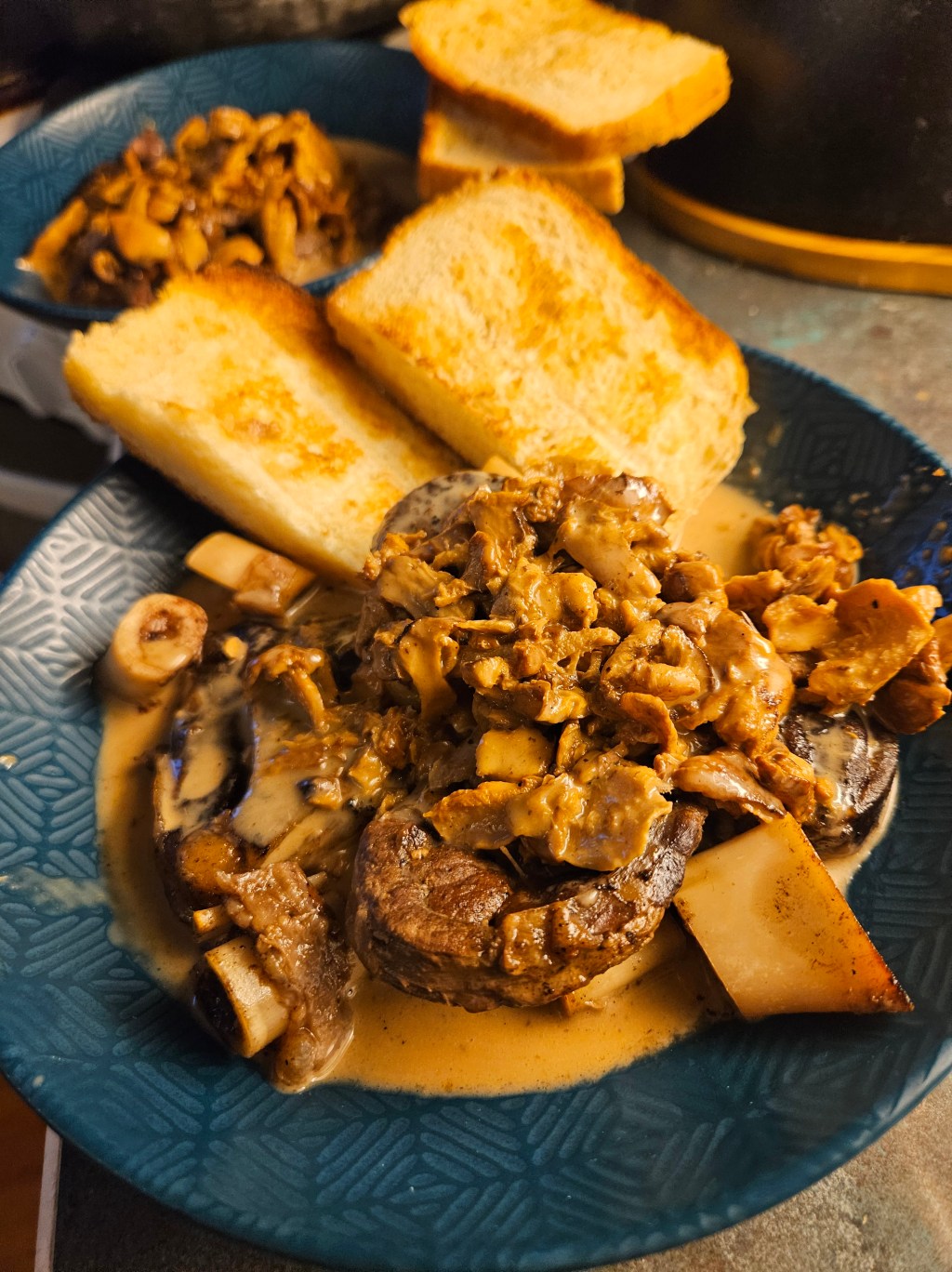
For the sauce: those butter-fried chanterelles go into a pan, hit them with a splash of the braising liquid if you want, then pour in the ruokakerma and let it simmer until it coats a spoon.

The cream mellows everything, so taste and adjust. Finnish cooking cream is one of those ingredients I genuinely miss when I’m back in the States – it’s meant for sauces in a way American heavy cream isn’t quite.

The verdict:

My son, who is eleven and has been known to reject entire meals over Wrong Onion Energy, ate braised venison osso buco with foraged chanterelle cream sauce. His complaint? The black pepper made it “a little spicy.” His negotiation? Cherry Coke to wash it down.

Reader, that’s a win. I’ll take it.

And me? I kept the marrow bones. Chef’s privilege. If you’ve never poked osso buco marrow out with a chopstick and eaten it straight, I recommend the experience. It’s buttery and unctuous and feels vaguely illicit, like you’re getting away with something.

If you saw “Braised Venison Osso Buco with Wild Chanterelle Cream Sauce” on a restaurant menu, you’d expect to pay €35 minimum. This cost me about €5 for the venison (bought in bulk, whole deer), maybe €2-3 in cream and seasonings. The chanterelles were free if you don’t count the walking, which I don’t, because that’s the point. The wine was traded for plants I was going to dig out anyway. The Tatung has been earning its keep for thirteen years.

But the real currency isn’t euros. It’s time. Time in a place. Time building the life that puts hunted venison in your freezer and foraged mushrooms in your butter and your friend’s wine in your braise.

This dish doesn’t have a nationality. Finnish ingredients, Taiwanese equipment, Californian cook. It just has a biography.

Mine, apparently.


Tatung Braised Venison Osso Buco with Chanterelle Cream Sauce

Serves 2-3 hungry people

For the braise:

  • Venison osso buco, ~600-700g
  • Red wine, ~½ cup (for deglazing)
  • Water, 1 cup (for Tatung outer pot)
  • Meat bouillon cube, 1
  • Celery, 2-3 stalks cut in chunks
  • Bay leaf, 1
  • Salt and pepper
  • Oil for browning

For the chanterelle cream sauce:

  • Chanterelles, fried in butter (fresh or frozen)
  • Ruokakerma (Finnish cooking cream), ½ to ¾ cup
  • Splash of braising liquid
  • Salt and pepper to taste

Method:

Brown the osso buco in a hot cast iron pan – 2-3 minutes per side until you get a proper golden crust. Work in batches. Patience.

Deglaze the pan with wine, scraping up all the fond.

In your Tatung (or slow cooker, or Dutch oven at 150°C): add water and bouillon to outer pot, nestle meat in inner pot, pour wine over, tuck celery and bay leaf around. Lid on, switch down. Walk away for 2.5-3 hours.

For the sauce: warm the butter-fried chanterelles, add a splash of braising liquid, pour in cream, simmer until it coats a spoon. Season to taste.

Serve over crusty bread. Keep the marrow bones for yourself.

Six on Saturday | 23rd September 2023

It’s been a gentle September, a couple of chilly nights aside. With the mellow temperatures and increased rainfall has come an amazing mushroom foraging season. The late autumn mushrooms are appearing earlier and the late summer mushrooms are still out in droves, so that I can’t walk from the house to the garage without coming across an edible mushroom. After only wandering within a 500-meter radius of the house for a couple of hours, I had 4 full baskets totaling 6.26kg of mushrooms. Guess who is spending the weekend preserving all that?

1. The golden chanterelle (Cantharellus cibarius) is plentiful in Finnish woodlands and easy to spot once you know what you’re looking for. This year, they have gone completely nuts. Clumps are growing on the neighbor’s lawn. I took out the garbage and came back with a handful of chanterelles. Luckily, they are also our favorite and can be used in countless different ways. Mushroom pasta and risotto are especially popular in our household.

2. Funnel chanterelles (Craterellus tubaeformis) have been growing very large this year, many as big as the yellows. They can pretty much be substituted for each other in just about any recipe. The funnels usually don’t start sprouting until next month, but I’m not complaining.

3. Another chanterelle relative, the hedgehog mushroom is also plentiful in our woods. The one in the picture is the more common Hydnum repandum but we also have a clump of Hydnum rufescens growing under our clothes drying rack. These first three are all pretty much interchangeable in recipes and have very similar flavors, though I like the firm texture of the hydnums the best.

4. A group picture of all the different species sorted into their own baskets. Also included so I can show the two porcinis (Boletus edulis) I found next to the swing set in the top left basket.

5. These are not the yellow and red ‘Jackpot’ gladiolus I expected when planting these bulbs, but I prefer whatever it is I ended up with. They fit in better with the color scheme of the rest of my plants, honestly. Don’t tell that to my son, though — he chose the bulbs because he likes orange.

6. The double red begonias finally decided to show themselves, right when I’d given them up as a lost cause. I admit that they are pretty, though perhaps they might just stay on the terrace in a pot next year.

Thanks for visiting and please do check out what the other SoSers are doing over at Jim’s page!

Dandelion Jelly Time

For the past few years, I have been looking forward to the end of May because it means… jelly-making time! We’ve always observed an unofficial sort of No-Mow May, if only because things don’t really dry out and start growing until June anyway. Even the weeds take a while to get going this far north, so there doesn’t seem to be any point in fueling up the mower. Meanwhile, our lawn got a lot of impatient glares as I kept peeking out to see if there were enough fluffy yellow blooms yet to warrant getting out of my jam jars.

And finally, at the end of last week, there they were! Which was good, because our supply from last year was just about depleted. Out of all the flower jellies I have experimented with, dandelion was the only one that leaped to “be sure to make enough to last for the year” status. It tastes like honey, but in a scoopable jiggly format, which makes it especially kid-friendly.

There are tons of recipes online for making floral jelly, so I’m not going to format one here. My food blog days are far behind me and this is mostly a diary to share with family and friends. Also, I use a mishmash of US and EU measurements that I’m sure will annoy people on both sides of the Atlantic.

Right! I make my infusions in 1.8L IKEA jars because we have so many of them around for storing dry goods. Each one gets 4-4.5 cups of dandelion petals. I think one of the best parts of making this jelly is sitting in a patch of flowers on a sunny day, lazily plucking petals and listening to audiobooks.

Once the jar is full, it’s filled with boiling water and steeped for 24 hours. It gets moved to the fridge after it cools down a bit. Actual cooking process, speed run: 8 cups infusion, 1.5 teaspoons citric acid, 35g pectin powder, and 7 cups sugar. With bulk pectin powder, I find it easier to mix half the sugar and all the pectin in a shaker, then slowly stir it into the warm infusion. Everything dissolves so much easier that way. When the liquid is looking smooth, turn the heat up and stir in the rest of the sugar, then let it boil for one minute. Meanwhile, the hot water canner is warming up the jars and the lids, which are then pulled out just in time to be filled with jelly. They are processed for 10 minutes, then tucked away in the root cellar to set and store.

What do we use all that jelly for? Sandwiches, mostly. I also like it in porridge and yogurt. The picture above is of homemade peanut butter and dandelion jelly sandwiches from a couple of summers ago. Which reminds me, I really should be make more bread this summer…